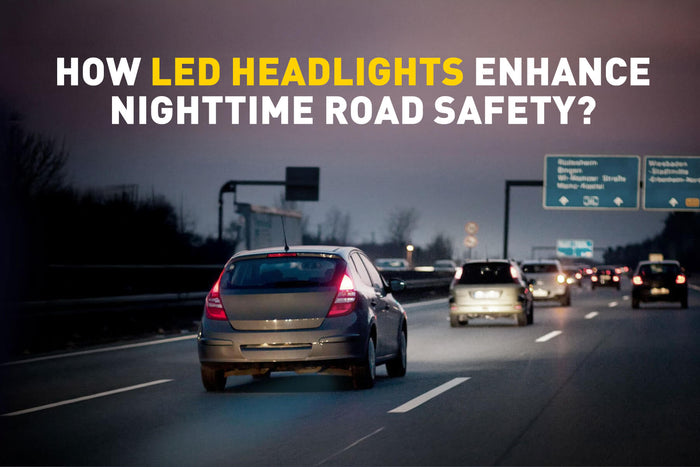
Car headlights are crucial for safe driving, but their effectiveness depends on proper alignment. A key factor is the bulb's beam pattern, essential for clear night driving and minimizing glare. This article delves into LED headlight bulb beam patterns—types, factors, and adjustments. Gain insights to ensure your headlights' safety, effectiveness, and your driving security.

Based on the cut-off line of the beam pattern, we can divide the beam pattern into two common standard beam patterns: European Standard Beam Pattern (ECE) and American Standard Beam Pattern (DOT).
The standard measure is a beam with a sharp, asymmetrical cut-off. The half of the beam closest to oncoming drivers is flat and low (left side), while the half of the beam closest to the outside of the road slopes up and towards the near side of the road.

Also sharp and asymmetrical beam pattern; the half of the beam closest to oncoming drivers is also flat and low, but not as low as the ECE beam pattern. The half of the beam closest to the outside of the road is also flat, but higher than the half closest to oncoming traffic.

Both the ECE and DOT beam patterns have sharp and asymmetrical cutoffs to render the low beam pattern correctly. This design prevents the light from glaring at oncoming drivers while allowing enough illumination to see pedestrians, road signs, hazards, etc. Next, let's explain in detail why the light bulb beam pattern is so important.
(By the way, if you want to know more about cutoff lines, please read-CUTOFF LINE - ENHANCING HEADLIGHT AIMING AND DRIVING SAFETY)
A good, correct beam pattern allows the headlights to fully perform their lighting effects, enhancing road visibility and preventing bright lights from dazzling others. You'll be thankful that others didn't flash their lights on you for being blinded by the lights, and other drivers will be thankful that they can see your car clearly. However, if the headlights emit a bad beam pattern, it will make oncoming drivers feel dizzy, and the road illuminated by the lights will have overlapping shadows. In severe cases, it may affect driving at night and increase the chance of accidents.
So we need to check and make sure that the beam pattern of our headlights is good, then you may wonder under what circumstances the beam pattern of my car headlights needs to be adjusted. Don't worry, before we answer this in this article, let's take a look at the factors that affect the light bulb's beam pattern.
The design and materials used for the headlight housing also affect the beam pattern emitted by the LED bulb. Although different car designs have different types of headlights, they are roughly divided into projection headlight housings and reflector headlight housings.
When an LED bulb emits light, the light is reflected and scattered off the surface of the headlight housing. The shape and material of the enclosure affect how and to what extent these optical phenomena occur, changing the shape and direction of the beam of light. For example, a housing with a convex lens shape can focus the light into a more concentrated beam, increasing the brightness and illumination distance of the high beam; while a housing with a concave reflector can reflect the light into a wider angle, increasing the low beam. The lighting range of the lamp. The projection headlight has a lens that acts as a magnifying glass, which can increase the brightness of the light speed pattern, and the designed cut-off cover is also conducive to the light shining on the road. Additionally, the transparency, reflectivity, and scattering of housing materials can also affect the beam pattern.

If you want to know more about which one is more suitable for LED bulbs, projector headlights or reflector headlights, please read - WILL LED BULBS WORK IN PROJECTOR HEADLIGHTS? | MUST SEE!
The shape of the LED bulb chip and the arrangement of the lamp beads will also have a direct impact on the beam pattern emitted by the bulb. The reason is different light spots between matrix and linear arrangements. Generally speaking, the arrangement of rectangular lamp beads can emit a wider beam pattern, while the arrangement of square lamp beads can emit a more focused beam pattern.

In addition, the material of the LED bulb chip, the thickness of the gap between the lamp beads on both sides, and the placement method will also affect the beam pattern of the LED headlight bulb. To put it simply, the closer the chips on both sides are, the smaller the gap is, and the light-emitting point can diverge in 360 degrees, making it easier for the bulb to focus on one point while fully diverging the light source. Its beam pattern is also relatively more focused and wider.

Optical design includes the design of reflectors, lenses, and other optical components, which can affect the beam pattern by controlling the optics inside the LED bulb. For example, the shape and position of a lens can affect the focusing and scattering of a beam, thereby changing the shape and direction of the beam. In addition, the shape and material of the reflector can also affect the spreading and focusing of the beam. Therefore, we provide a headlight assembly with a 1:1 design with the original car's factory headlights, which includes reflectors, lenses and other optical components, in order to ensure the output of the same size, clear and correct headlight beam pattern.

The thermal management of an LED bulb can also affect its beam pattern. If heat dissipation is poor, the LED bulb may overheat, causing the refractive index of light change and affecting the shape and direction of the beam. Therefore, good thermal management is important to maintain the beam pattern of LED bulbs. We pays extra attention to heat dissipation in every LED bulb design, adopting a full aerospace aluminum body for heat conduction in the bulb, along with a 12,000-rpm cooling fan for rapid heat dissipation, thus effectively dissipating heat during high-brightness illumination to ensure the effective output of the bulb's beam pattern.

The quality of the bulb, optics, and LED chips all affect the consistency and stability of the beam shape. Manufacturers can create bulbs with specific beam patterns for different lighting applications by optimizing the size, shape, and layout of the chips. Therefore, purchasing high-quality LED bulbs is also the basis for ensuring that the bulbs produce good beam patterns.

In conclusion, every component in the headlight assembly affects the output of the beam pattern of the LED bulb, and only by ensuring that the relevant factors affecting the beam pattern are normal, can we consider other issues besides the bad beam pattern of the bulb itself.
After understanding the factors that affect the beam pattern of LED headlights, let's talk about when you need to adjust your headlight beam pattern.
There are a number of signs that your headlights may need a beam pattern adjustment. Here are some enumerated points:
When the beam from your headlights is too high or pointed in the wrong direction and dazzles oncoming drivers, other drivers will flash their high beams at you to let you know that your headlights are blinding them.
If you cannot see the road ahead clearly even with the headlights on or if the road ahead is only brightly illuminated for 20 feet or so, this may indicate that the beam pattern is misaligned or too dim.
If you notice that one headlight is brighter or illuminates a larger area than the other, this could indicate a misalignment of the beam pattern.

If your headlights are aimed too low, you may not be getting enough illumination of the road ahead of you, and then you'll have a hard time seeing obstacles. Conversely if it's too high, you risk blinding oncoming drivers.
If you notice any of these signs above, it could be a sign that you need to adjust your headlight beam pattern as soon as possible. This ensures that your headlights provide optimum visibility and minimize glare to other drivers on the road. Next let's talk about how to adjust the headlight light to the correct beam pattern.
LED headlights can be adjusted to the correct beam pattern in two ways: externally and internally.
If you install a new LED bulb improperly, the light angle will be incorrect, which will have a scattering beam pattern.
So here are the detailed steps:
![]() |
![]() |
(Warm tip: If you want to know the solution of LED lighting scattering, please read - IMPORTANCE OF BEAM PATTERNS AND SOLUTIONS TO LED LIGHTING SCATTERING)
Adjusting your car's headlights is a simple and effective process that ensures better visibility and safety during nighttime driving. Here's a simplified version of the steps:
By following these steps, you can easily adjust your car's headlights for optimal performance and safer nighttime driving.
(Warm tip: If you want to learn more about the detailed operation of headlight beam pattern aiming, please read this blog-HEADLIGHT ADJUSTMENT AIMING WALL CHART)

After completing the above two methods of operation, congratulations on getting a high performance LED bulb with the correct beam pattern again.
Bulb beam pattern is an often overlooked but crucial aspect of lighting. They greatly affect the effectiveness and aesthetic appeal of a lighting setup. Knowing the factors affecting the beam pattern of LED bulbs and how to adjust them can greatly enhance your car's lighting and keep you safe. Please remember that when you feel that your headlights are dimmed or other lighting effects are reduced, please adjust your headlights in time. Always check and make sure the beam pattern of your headlights is good.
A: In addition to the incorrect aiming adjustment mechanism of the vehicle, the aiming error of the light bulb beam pattern may also be caused by the following factors.
At this time, you need to re-adjust the alignment position of your headlight beam.
A: The ideal headlight beam pattern is one that maximizes the driver's visibility while minimizing glare to other drivers on the road. Divided into two modes: high beam and low beam. The dipped beam pattern should have a sharp cutoff at the top of the beam, with a clear cutoff preventing the light from reaching the eyes of oncoming drivers. At the same time, the light should be uniform and broad enough to illuminate the entire width of the road ahead. The high beam mode is turned on when there are no passing vehicles, and the light needs to be wider and more uniform so that you can see clearly in the distance.

A: Because the headlight alignment can ensure your safety and the safety of other road users or others. If your headlights are misaligned, in addition to reducing your driving visibility, it can cause glare to other oncoming drivers and increase the chance of accidents. Besides, the alignment of headlights can ensure lighting efficiency and compliance with traffic laws and regulations, avoiding the risk of being punishment.
![]() |
![]() |
A: This can cause reduced visibility, which is a big problem when driving at night. And there will be a high chance of causing glare to other drivers while not complying with traffic regulations. When you drive at night, in addition to the difficulty in judging the distance, you will also not be able to respond in time to things that suddenly appear on the road, which increases the risk of accidents.
Leave a comment